
2025 Update and Outlook
A revealing discussion of how the most intriguing hedge funds performed last year and a look at the opportunities and risks that lay ahead.
Hi Eric, hope your year ended well and good to reconnect. Looking at your year-end wrap-up, there’s clearly a lot to talk about. Let’s start with what were the key takeaways from how your Top 50 hedge funds performed last year?

Good to reconnect Linus…I ended 2024 over the ocean heading to Italy. When I returned back to the States in late January, I found myself in a very different country from the one I had departed. More about that later.
There were several compelling takeaways from my year-end report.
To remind folks who may not know about my Top 50 hedge funds, at the beginning of every year I survey the industry to find the most consistently performing broad strategy hedge funds that have at least five years of performance and are managing at least $300 million. They all need to straddle performance hurdles for each of the past five years.
I then rank the highest performers over the trailing 5 years through 2023.
Throughout 2024, I tracked how these funds performed quarter over quarter. This latest report provides final full-year 2024 performance numbers of these 50 hedge funds.
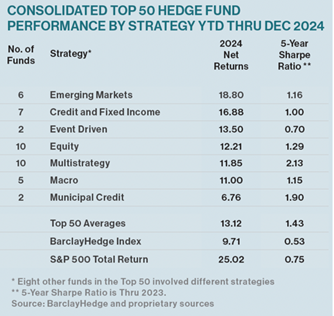
Collectively in 2024, the 50 (up 13.1%) kept pace with their 3- and 5-year annualized returns (12.3% and 13.7%), and their average returns since inception — with a mean fund age of 15 years (11.4%). More than 80% of the funds have qualified for the 2025 survey.

Are you concerned that your 50 significantly trailed the US market?
No.
The market has been on a crazy good run, outpacing its historic rate of return by 100% over each of the past two years. The last time the market had multiple 20+% years was followed by the Tech Wreck.
Even if such a correction doesn’t happen this time, alternatives are not meant to keep pace with a hyper market. They target more even returns.
Most investors should maintain significant market exposure. The Top 50 targets steadier, less volatile returns that over time closely track the market. The 5-year annualized returns of the 50 thru 2023, for instance, was 13.7%, just two percentages less than the market and these funds delivered these gains with a lot less risk.
When you dig deeper, what else did you find about the 50’s performance?
As we’ve been discussing recently, the big surprise was six emerging market funds that made the cut and were the best performing strategy from wire to wire through December 2024.
Two funds, Sandglass and Enko (both credit managers who had joined us in our EM webinar last fall) actually delivered market-beating returns.
That always makes me wonder whether this year they’ll give back some of these gains, especially since they massively outperformed their annualized rates of return. So I asked the PMs that question.
They anticipate more restrained but positive returns in 2025 because their active management approach targets relatively short-term idiosyncratic investments supported by EM being in an attractive phase of the debt cycle.
That said, I would still be skeptical. Both of these funds have seen drawdowns of 20%. However, these funds have each been around for a decade and ostensibly have stayed true to an effective investment process that has delivered consistent returns. Enko, in fact, has never had a down year.
Any other funds stand out?

Mudrick Distressed had one of the most remarkable turnarounds I’ve ever seen. I interviewed the manager, Jason Mudrick, in last year’s report because he is one of just a dozen funds that have made my survey since I started the current methodology in 2019 when The Wall Street Journal published my report.
His fund was launched in 2009 and has been generating annualized returns of 10% through 2023.
However, 2024 started off rough for Mudrick, having been down more than 8% in the first quarter. But the fund ended the year up 32% because of a series of effective investments that ranged from debt for equity to a senior secured convertible issue that benefited from a favorable judicial ruling and then a buyout offer.
Is the fund at risk of mean reversion this year?
Over its 16 years, the fund has had three distinct years of 20+% returns and each was then followed by more modest positive gains. Being an idiosyncratic investor that embraces a disciplined investment process suggests that Mudrick knows how to sustain returns after a strong year. It certainly doesn’t hurt with $5.5 trillion in junk bonds overhanging the distressed market and likely offering plenty of opportunities from which to invest.
Sounds like credit was a leading strategy in your Top 50. Did any other strategy stand out?
Hedged equity, multistrategy, and macro jointly averaged around 12%. These are decent returns for underlying funds that have delivered long-term consistency across all markets.
In these groups, the big names did shine. Citadel Tactical Trading (equity) returned 22.3%. Point 72 (multistrategy) delivered gains of 18.6%. And macro trader D.E. Shaw Oculus soared by more than 36%. All these funds significantly outperformed their historical rates of return.
Any other surprises?
Yes, and they were on the downside. Waha MENA equity, like Mudrick Distressed, has regularly made the Top 50. Mohamed El Jamal’s Abu Dhabi-based fund had ascended to the No. 6 ranking with trailing 5-year annualized returns through 2023 of 20.6%. But it struggled all last year, gaining just 1.6%.
Making this doubly surprising was that El Jamal’s Waha EM Credit fund racked up gains of 18.4% last year.
The other big underperformer was noted activist Starboard Value. The fund has been around for more than two decades with annualized returns of 13.5%. It managed a gain of just 4.2% in 2024.
You mentioned returning home in January to a different America. What do you mean?
Despite the pandemic, supply chain shocks, inflation, rising interest rates, and war, the US economy has been remarkably resilient. But the new administration is stressing it in new ways that no one has ever seen before.
We’re seeing the administration break foundational rules and norms. Congress seems OK ceding over its policy and budgetary authority without regard to process or consequences. We’ll soon see what the courts think given the many challenges being brought against Trump and if the administration will abide by unfavorable court rulings.
The Supreme Court’s very recent decision to hear a case where lower Federal courts ruled the administration had to pay foreign aid contractors who have already completed work will be a bell-weather decision.
What other risks do you see?
I think it’s too early to interpret 2025 data points. But collectively, many are pointing in the wrong direction. That includes from inflation and consumer sentiment, insider-selling, and Europe’s significant outperformance over US stocks.
We’ll need to watch if and how far these trends evolve.
For sure it hasn’t been profitable to bet against the US. But there’s no reference point to gauge the effect of what’s going on right now.
Do you think the new administration’s actions will directly affect the economy and markets?

When not done methodically, I think most folks are concerned how significant Federal job cuts will affect performance of key government infrastructure that supports all facets of US life—business as well as family. This ranges from health and human services, law enforcement, the collection and enforcement of taxes, air travel and consumer protection to how states and cities govern, down to basic civil rights. And when these cuts are geographically concentrated in places like Virginia, they will immediately slow local spending.
If these actions proceed, they will also likely end up transferring costs to state governments, most of which are unable to handle the added financial burden.
Lars Christensen is a well-regarded Danish economist who I interviewed several years. In assessing what’s going on, he sees, “a historically unprecedented administrative collapse at the top of the American state. The financial markets will react strongly to this”.
And internationally?

There’s widespread agreement that significant tariffs will probably restart inflation and threaten the Fed’s decision (and the ECB’s) to cut rates any further. If this happens, growth will likely slow.
The President is challenging key European alliances and support for Ukraine. This will shake things up. Demanding in-kind mineral payments from Ukraine for continued assistance is to ignore the cost the country is paying in blood, property, and treasure for defending itself and the West from Russian aggression. Ukraine will need these resources to rebuild its economy.
(Conversely, it’s noteworthy that the Trump administration is not discussing Russian war reparations to Ukraine.)
If Europe decides to fast track expansion of its arms industry, this will redirect spending inwardly and away from the US. Germany’s next Prime Minister Friedrich Merz just said, “The absolute priority will be to strengthen Europe as quickly as possible so that, step by step, we can really achieve independence from the US.”
If Europe decides to fast track expansion of its arms industry, this will redirect spending inwardly and away from the US. Germany’s next Prime Minister Friedrich Merz just said, “The absolute priority will be to strengthen Europe as quickly as possible so that, step by step, we can really achieve independence from the US.”
Bret Stephens of the New York Times summed things up this way:
“But if it’s a financial payback that the Trump administration seeks, the best place to get it is to seize, in collaboration with our European partners, Russia’s frozen assets and put them into an account by which Ukraine could pay for American-made arms. If the United States won’t do this, the Europeans should: Let the Ukrainians rely for their arms on Dassault, Saab, Rheinmetall, BAE Systems and other European defense contractors and see how that goes over with the “America First”-ers. Hopefully that could serve as another spur to Europeans to invest, as quickly and heavily as they can, in their depleted militaries, not simply to strengthen NATO but also to hedge against its end.”
What are your sources telling you about all this?
On the record, everyone I’ve been speaking with is putting on confident faces. But privately, many are baffled and are just hoping that common sense prevails. I don’t see that happening because Trump this time has intentionally surrounded himself with folks who either aren’t experts in their fields or unwilling to challenge his thinking.
I suspect if there isn’t a return to more thoughtful policies and norms, investors may begin to reduce risk taking which could in turn further slow growth.
Citadel’s Ken Griffin, a key Trump ally, says, “it’s a difficult time to invest because of the policy uncertainty that goes on with this (administrative) transformation.”
Thanks Eric, good to have you here again. You can find more of Eric’s writing here.
Pingback: 2025: Looking Ahead by Uhlfelder